
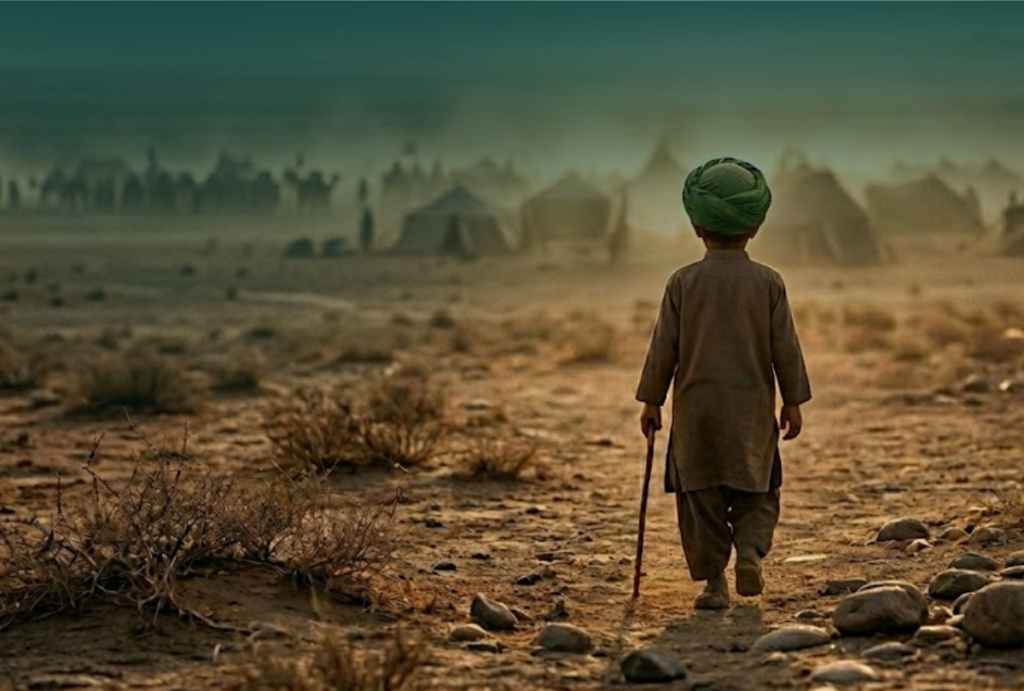
The life of Imam Muhammad al-Baqir is a powerful example of how knowledge, patience, and spiritual strength can transform a community.
Born in Medina on the 1st of Rajab, 57 AH, Imam al-Baqir (as) lived through a time of political unrest, continued sorrow after Karbala, and intense pressure under Umayyad rule.
Yet, in the middle of these challenges, he became one of the most influential teachers and scholars in Islamic history.
Allah (swt) says in the Holy Quran:
“Obey Allah (swt), obey the Messenger (saww), and those vested with authority from among you.”
Surah An-Nisa, Ayah 59
From this guidance, believers understand the importance of divinely guided leadership.
Imam al-Baqir (as), as part of the Ahlulbayt (as), carried forward the message of Islam with clarity, wisdom, and sincerity.
His life reflects the balance between deep scholarship and spiritual reflection, all rooted in devotion to Allah (swt).
Lineage, title, and significance
Imam al-Baqir (as) was the fifth Imam from the Ahlulbayt (as).
His father was Imam Sajjad (as), while his mother was Lady Fatima bint Hassan (sa), the daughter of Imam Hassan (as).
This blessed lineage connected him directly to both Imam Hassan (as) and Imam Hussain (as), the grandsons of Prophet Muhammad (saww).
He was known by the title “al-Baqir”, meaning “the one who splits open knowledge”.
This title reflects his ability to uncover, explain, and expand the deeper meanings of Islamic teachings.
Imam al-Baqir (as) is often seen as the bridge between the tragedy of Karbala and the later expansion of Islamic scholarship under Imam Ja‘far al-Sadiq (as).
Through patience and careful teaching, he preserved the teachings of the Ahlulbayt (as) during a time when they were under threat.
Karbala and his early life
The suffering of Imam Hussain (as) and his family remained deeply embedded in his identity and teachings.
Imam al-Baqir (as) is reported to have said:
“Humans, jinns, birds and beasts; all shed tears on Hussain ibn Ali (as).”
Kamil al-Ziyarat, ch.26, h.1
This narration highlights how the tragedy of Karbala was not only a historical event but a universal moment of grief.
Imam al-Baqir (as) ensured that the message of Karbala remained alive, reminding believers that it represents the struggle between truth and oppression, and the importance of standing firm on justice.
A legacy of knowledge and teaching
One of the greatest contributions of Imam al-Baqir (as) was his revival of Islamic learning.
During his Imamate from 95 AH to 114 AH, he taught students in Medina in subjects including fiqh, tafsir, theology, ethics, and spirituality.
His teaching circles became some of the earliest organized centers of Islamic learning.
The knowledge he spread later helped form the foundation of the Ja‘fari school of thought, which was expanded further by Imam al-Sadiq (as).
Imam al-Baqir (as) encouraged thoughtful learning and reflection rather than blind imitation.
He is reported to have said:
“Revising knowledge for an hour is better than staying up the whole night in worship.”
al-Ikhtisas, p.245
This teaching reminds believers that learning with sincerity is itself an act of devotion.
Knowledge strengthens faith when it leads to humility, reflection, and better character.
Character, spirituality, and justice
Imam al-Baqir (as) was widely known for his humility, patience, and kindness.
His teachings often focused on inner purification and the importance of good character alongside external worship.
Imam al-Baqir (as) is reported to have said:
“Know the amity that your brother has for you in his heart through what you harbour of the same in your own heart.”
Kashf al-Ghamma, v.2, p.331
This narration encourages believers to build relationships based on sincerity, empathy, and self-awareness.
It reflects how Imam al-Baqir (as) taught not only through words but also through example, shaping communities built on trust and compassion.
He also spoke strongly against injustice during the Umayyad period, reminding people that oppression carries consequences even if it appears powerful in this world.
He is reported to have said:
“The wronged one profits much more from his oppressor’s Hereafter (i.e. his account of deeds) than the oppressor profits from the world (i.e. the wealth or honour) of the one he is wronging.”
Bihar al-Anwar, v.75, p.311, n.15
His words continue to inspire believers to remain patient in hardship, uphold justice, and trust in Allah (swt)’s ultimate judgment.
His martyrdom and lasting legacy
He was laid to rest in Jannat al-Baqi in Medina beside Imam Hassan (as) and Imam Sajjad (as).
His legacy continues to live through the preservation of Islamic knowledge, the teachings of the Ahlulbayt (as), and the moral and spiritual lessons he left behind for future generations.
Imam al-Baqir (as) is also reported to have said:
“‘Every eye will cry on the Day of Judgment except for three: an eye that stayed up (in worship) for the sake of Allah (swt), an eye that filled with tears out of fear of Allah (swt), and an eye that looked away from things prohibited by Allah (swt).”
Bihar al-Anwar, v.7, p.195, n.62
As believers reflect on his shahadat, his life continues to serve as a reminder that true success lies in knowledge, sincerity, worship, and commitment to justice.
Frequently Asked Questions
Imam al-Baqir (as) was the fifth Imam and a leading scholar from the Ahlulbayt (as). He played a major role in preserving and teaching Islamic knowledge after Karbala.
The title “al-Baqir” means “the one who splits open knowledge”. It refers to his deep understanding and explanation of Islamic sciences.
Imam al-Baqir (as) was born on 1 Rajab, 57 AH in Medina.
Imam al-Baqir (as) was poisoned on the orders of the Umayyad ruler Hisham ibn Abd al-Malik and attained martyrdom on 7 Dhul Hijjah, 114 AH.
He helped revive Islamic scholarship by teaching hadith, Quranic interpretation, ethics, theology, and law. His teachings later contributed to the development of the Ja‘fari school of thought.
Imam al-Baqir (as) is buried in Jannat al-Baqi in Medina alongside other members of the Ahlulbayt (as).
More from Blog

Bridging the Digital Divide Through Education
Explore how technology can make education more accessible and create equal learning opportunities for children. Support digital inclusion and help equip young…

The Future Starts with Education
Help vulnerable children access education, technology and skills for a brighter future. Support The Zahra Trust with a Back to School gift…
Rebuilding Futures Through Education: Restoring Hope, Dignity and Opportunity
When communities experience crisis, the effects can continue long after the immediate hardship has passed. Conflict, poverty, and displacement can interrupt a…