
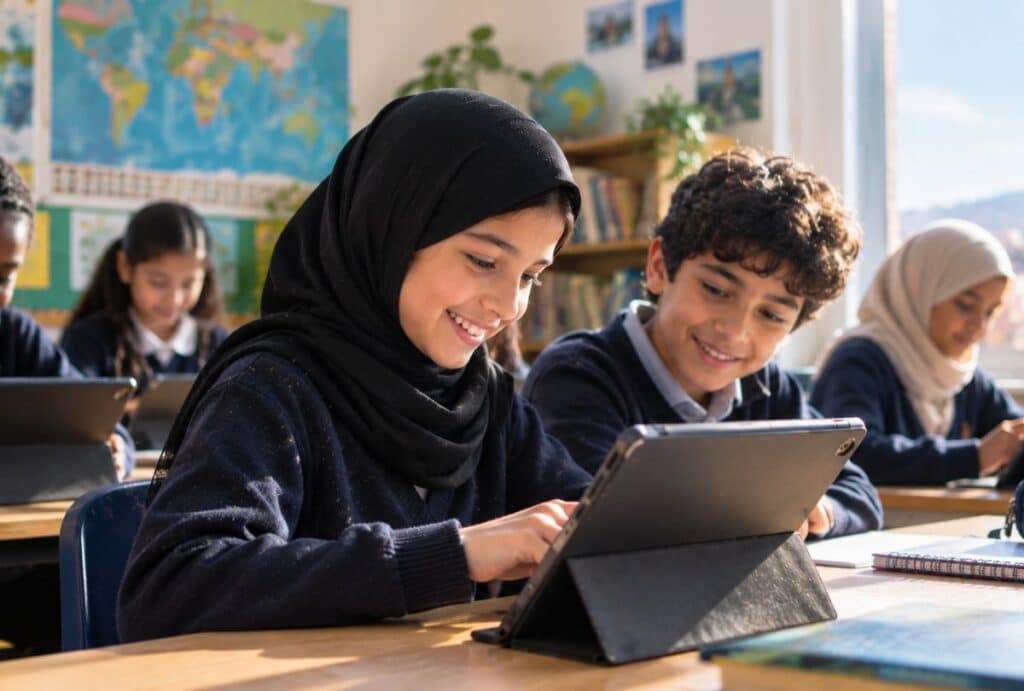
Education can give children the knowledge, confidence and skills they need to participate fully in society. As classrooms increasingly incorporate digital tools, access to technology is becoming an important part of that educational experience.
But the digital divide is not simply a question of who has a computer or an internet connection. It includes several layers of inequality, from the affordability and reliability of connectivity to digital skills, teacher training, accessible resources and the availability of educational content that meets the needs of different learners.
For children experiencing poverty or living in underserved communities, these barriers can be particularly difficult to overcome. A young person may have a phone but be unable to afford enough data for regular online learning. A school may have digital equipment without sufficient training for teachers. Online resources may also be unsuitable if they are not accessible, culturally relevant or available in the languages learners understand.
Bridging the digital divide through education means addressing these challenges together. Technology should be a means of expanding opportunity, helping every child access meaningful learning and develop the knowledge and skills needed for their future.
The importance of seeking knowledge is also reflected in the Quran:
This verse reminds us of the value of continually seeking knowledge and understanding.
How Technology Creates More Equal Learning Opportunities
When digital tools are introduced with inclusion and accessibility in mind, they can help reduce some of the barriers that prevent children from receiving a quality education.
Expanding Access to Quality Educational Content
Digital education can give students access to resources that may not be available in their local schools or communities. Online courses, digital libraries, educational videos, open resources and electronic textbooks can broaden the range of material available to learners.
For students in rural or under-resourced communities, this can be particularly valuable. Geography does not have to be the only factor determining which learning materials a child can access.
Digital resources can also allow students to revisit lessons and study at a time that suits their circumstances. When designed appropriately, technology can complement classroom teaching and provide additional opportunities for practice and exploration.
Personalizing the Learning Experience
Children have different strengths, challenges and learning speeds. A single approach may not work equally well for everyone.
Adaptive educational technology can help respond to these differences by adjusting activities, difficulty and feedback according to a student’s progress. These tools can give learners additional opportunities to practise areas they find challenging while allowing others to move forward when they are ready.
Artificial intelligence may offer further opportunities for personalized support, including tailored explanations and learning activities. However, effective use requires thoughtful implementation and should enhance the role of educators rather than remove the human element from learning.
Supporting Children with Different Abilities
Inclusive technology can help children with disabilities participate more fully in education.
Screen readers can make digital text accessible to students with visual impairments. Speech-to-text tools can provide alternatives for learners who find writing difficult, while captions can improve access to video content.
Providing text, audio, visual and interactive materials can also give students different ways to engage with information. This reflects Universal Design for Learning, which encourages multiple approaches to accessing, participating in and demonstrating learning.
When accessibility is built into educational technology from the outset, more children can benefit from the same learning opportunities.
Breaking Down Language Barriers
Diverse communities include learners from many linguistic backgrounds. Language can therefore be an important consideration when developing inclusive education.
Translation tools and multilingual digital resources can help students understand lessons and participate more confidently. They can also support communication between educators, students and families.
At the same time, technology should not simply translate existing material. Educational content is more effective when it reflects the culture, language and experiences of the community it is intended to serve.
Making Learning More Flexible
For some children, learning cannot always take place according to a traditional school schedule.
Mobile-friendly educational platforms, downloadable lessons and resources designed to use less data can help students continue learning outside the classroom. This flexibility can benefit learners who face challenges related to transportation, family responsibilities, distance or other circumstances.
Where connectivity is inconsistent, combining digital education with offline resources can provide another way to maintain continuity. Designing education around the realities of learners’ lives can make digital learning more accessible.
What It Takes to Make Technology Truly Equitable
Simply providing a device does not automatically close the digital divide.
Students need dependable infrastructure, including electricity and internet connectivity. Families may also need affordable access to devices and data, along with support for ongoing costs such as repairs and connectivity.
Teacher development is another essential part of the equation. Educators need more than technical instructions. They need practical training that shows how technology can be incorporated into teaching, differentiated for individual learners and used to support assessment and engagement.
Students also require digital literacy. Knowing how to operate a device is only one part of being digitally capable. Young people need to understand how to find, evaluate and use information responsibly and safely.
Educational resources should also be inclusive and relevant. Language, accessibility, culture and local circumstances should be considered when selecting or creating digital content.
Finally, organizations need to look beyond the number of devices distributed or users registered on a platform. The more important questions are whether students are participating, learning and developing skills that can improve their future opportunities.
Learning from the Example of Imam Ali (as)
Knowledge has long been recognized as something of lasting value within the Islamic tradition. Education can provide more than academic information. It can help individuals develop the understanding and capabilities needed to navigate life and contribute to their communities.
Imam Ali (as) is reported to have said,
“There is no treasure more profitable than knowledge.” (al-Kafi, v.8, p.19, n.4)
This provides a powerful perspective on why educational support matters. Technology itself is not the treasure. A laptop, tablet, internet connection or training programme becomes meaningful because it can help a child gain knowledge and develop skills.
Bridging the digital divide through education is therefore about turning access into genuine learning. It is about making sure children have both the tools and the support required to benefit from them.
Building a Future Through Education and Technology
Technology has the potential to broaden educational opportunity, but lasting digital inclusion requires a wider commitment. Infrastructure, teacher development, accessible content, digital literacy and long-term support all have a role to play.
The Prophet (saww) is reported to have said,
For children and young people affected by poverty, pursuing knowledge can be made more difficult by circumstances beyond their control. Limited access to technology, training and educational support can affect their ability to learn today and prepare for tomorrow.
Investing in education can therefore mean investing in future opportunity.
A child needs the opportunity to learn today, but they also need the skills and confidence to build tomorrow.
For vulnerable children and young people, poverty can restrict access to technology, skills training and education. Their potential may be significant, yet without the right resources and support, turning that potential into opportunity can be much harder.
Your donation can help provide technology, skills training and education support, giving children and young people tools to learn, grow and prepare for life.
Give more than a lesson. Give a future.
Help children build the knowledge, skills and confidence to shape tomorrow. Support education that can create opportunities reaching beyond the classroom.
Frequently Asked Questions
What is the digital divide in education?
The digital divide in education refers to differences in access to devices, reliable internet, digital skills and appropriate educational resources. Factors such as income, location, language and ability can all influence a student’s access to digital learning.
How can technology help bridge the digital divide?
Technology can make educational resources more widely available, support personalized learning, improve accessibility for students with disabilities, address language barriers and offer flexible ways to learn. To be effective, these tools need to be accompanied by suitable infrastructure, affordability and support.
Why is digital literacy important for students?
Digital literacy enables students to use technology safely and effectively. It helps them access and assess information, communicate, learn independently and build digital skills that can support further education and future employment.
How can technology support children with disabilities?
Assistive technology such as screen readers, speech-to-text tools and captions can remove barriers to digital learning. Providing content in different formats can also allow students to participate and demonstrate their knowledge in ways that suit their needs.
What can educators do to make digital learning more inclusive?
Educators can identify students’ access to devices, connectivity and digital skills before selecting technology. They can use mobile-friendly and low-bandwidth resources, offer content in multiple formats, consider language and accessibility, and receive training focused on effective educational technology. Reviewing outcomes can also show where additional support is required.
More from Blog

The Future Starts with Education
Help vulnerable children access education, technology and skills for a brighter future. Support The Zahra Trust with a Back to School gift…
Rebuilding Futures Through Education: Restoring Hope, Dignity and Opportunity
When communities experience crisis, the effects can continue long after the immediate hardship has passed. Conflict, poverty, and displacement can interrupt a…

From Backpack to Graduation: The Ripple Effect of Education
Learn how an education donation can help remove barriers to learning and support a child's journey from school towards adulthood. Donate today…