
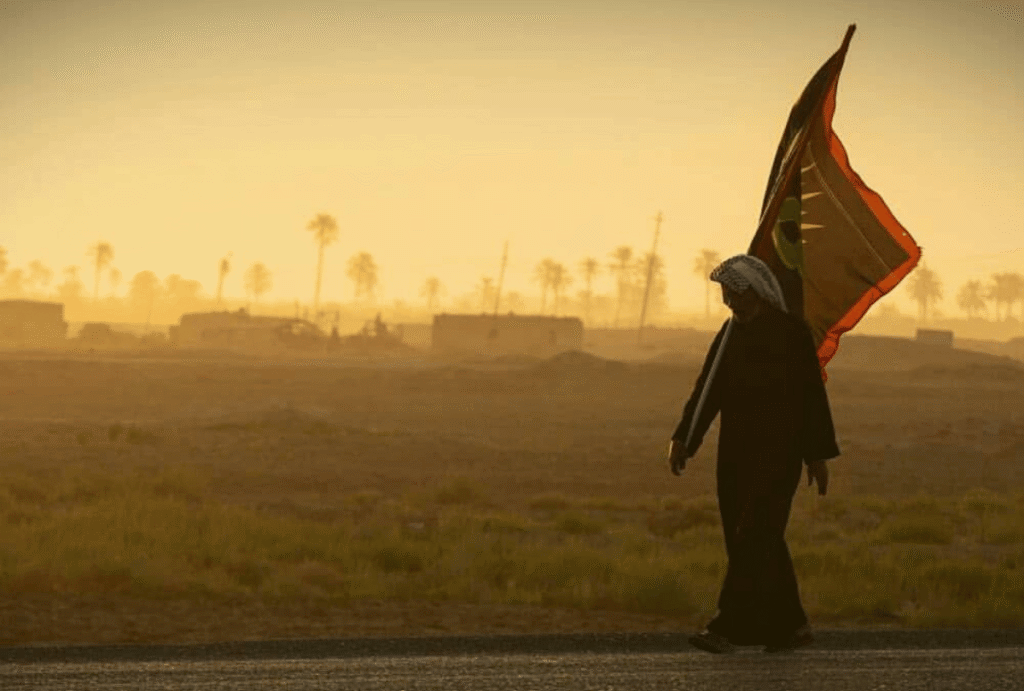
Forty days after the tragedy of Karbala, the pain had not faded.
The martyrdom of Imam Hussain (as) continued to live in the hearts of those who loved him. Yet the fortieth day became something more than an extension of mourning. It became a day of return, remembrance, and renewed devotion.
This became known as Arbaeen.
Today, millions travel towards Karbala each year. But the roots of this journey go back to the earliest days after Ashura, to the first known ziyarat of Aba Abdillah (as), and to the enduring tradition that remembers the return towards Karbala.
Understanding the meaning of Arbaeen
Arbaeen means “the fortieth” and marks forty days after the martyrdom of Imam Hussain (as).
Across Islamic tradition, forty days can represent a meaningful point in remembrance after loss. In Shia Islam, Arbaeen became deeply connected with ziyarat and preserving the message of Karbala beyond the battlefield.
Arbaeen is not simply about marking time.
It reflects the belief that Imam Hussain’s (as) stand did not conclude with Ashura. His message continued through remembrance, witness, and loyalty.
This relationship with the Ahlulbayt (as) is reflected in the Holy Quran:
For generations, believers have understood that love for the Ahlulbayt (as) calls for remembrance and action. Arbaeen became one of the most visible ways that devotion continues across time.
The earliest ziyarat and Jabir’s visit
Jabir, a companion of the Holy Prophet (saww), is widely remembered in Shia tradition as the first known visitor to the grave of Imam Hussain (as). Reports often mention that he travelled with Atiyya al-Awfi and reached Karbala on the twentieth of Safar.
His arrival became more than a personal moment of grief.
It became the beginning of a tradition of visitation that continues until today.
When standing at the grave, Jabir is reported to have called out the Imam’s (as) name three times.
Jabir is then reported to have asked, “Why a loved one does not answer one who loves him?”
He answers himself by reportedly saying, “How can he answer while his cheeks are torn, his head separated from his body?”
These words remain powerful because they express something at the heart of Arbaeen: love that refuses silence and remembrance that refuses to disappear.
The return towards Karbala: Tradition and historical discussion
One of the most meaningful parts of the first Arbaeen narrative is the reported return of the Ahlulbayt (as) to Karbala.
Many historical accounts describe that after leaving Shaam, they travelled through Karbala and visited the graves of the martyrs before continuing towards Medina.
These narrations hold deep spiritual significance and have shaped the way generations remember Arbaeen.
For that reason, this subject benefits from careful wording.
The return of the Ahlulbayt (as) to Karbala remains a cherished and meaningful tradition in Shia memory while historical discussion continues around the exact chronology.
Even with those discussions, the symbolism remains clear: the message of Karbala was not left behind.
From mourning to movement
The first Arbaeen shows that Karbala was never intended to remain a moment of grief alone.
Ashura revealed sacrifice.
Arbaeen carried that sacrifice forward.
The earliest visitors to Karbala demonstrated that remembrance itself can become an act of devotion.
This lesson continues today.
Arbaeen reminds believers that loyalty to Imam Hussain (as) is expressed not only through words but through service, generosity, and standing for values that outlive hardship.
Every journey made for Imam Hussain (as) becomes part of something larger than a single generation.
Preserving the message through the example of the Ahlulbayt (as)
Preserving the message through the example of the Ahlulbayt (as)
The Ahlulbayt (as) showed that preserving truth requires patience and perseverance.
After Karbala, Imam Zain al-Abideen (as) continued to protect the message of Imam Hussain (as) through worship, teaching, and remembrance.
Lady Zainab (sa) carried the story of Karbala forward and ensured that the sacrifice would not disappear beneath political power or silence.
Their example teaches an important lesson for Arbaeen.
Love for Aba Abdillah (as) is not passive.
It is reflected through remembering, serving, supporting others, and continuing the values for which he gave everything.
This understanding transformed Arbaeen from a moment in history into a living tradition.
Arbaeen is a living legacy
Over centuries, Arbaeen grew into a global act of devotion.
People come from across the world.
Some walk for days.
Some open their homes.
Some prepare meals.
Some support those making the journey.
The scale may have changed, but the intention remains rooted in the earliest days after Karbala.
The spirit of Arbaeen continues to unite remembrance with service.
Let your giving walk beside them
The first Arbaeen reminds us that remembrance did not stop with mourning.
Through ziyarat, loyalty, and continued devotion, the message of Imam Hussain (as) remained alive.
Whether through the first known pilgrimage of Jabir ibn Abdallah al-Ansari or the treasured memory of the Ahlulbayt (as) returning towards Karbala, Arbaeen became a declaration that Karbala would continue through every generation.
Today, millions journey towards Imam Hussain (as).
Support the people and communities serving this extraordinary movement.
Let your giving walk beside them.
Continue the movement through acts of service, generosity, and support for those carrying forward this sacred tradition.
Frequently asked questions
What is the first Arbaeen?
The first Arbaeen refers to the fortieth day after the martyrdom of Imam Hussain (as). It is remembered through the earliest ziyarat to his grave and the traditions connected to preserving the memory of Karbala.
Who was the first person to visit Imam Hussain’s (as) grave?
Jabir ibn Abdallah al-Ansari is widely remembered in traditions as the earliest known pilgrim to visit Aba Abdillah’s (as) grave on Arbaeen.
Did the Ahlulbayt (as) return to Karbala on Arbaeen?
Many historical narrations describe the Ahlulbayt (as) returning to Karbala after captivity, while historians continue to discuss the certainty of the exact dates and route.
Why is Arbaeen important?
Arbaeen represents remembrance, devotion, and continuing the message of Imam Hussain (as). It became associated with ziyarat and renewing loyalty after Ashura.
Why do people walk to Karbala for Arbaeen?
Walking to Karbala is understood as an act of devotion and remembrance that allows believers to express solidarity with Imam Hussain (as) and his mission.
More from Blog
The Future Starts with Education
Help vulnerable children access education, technology and skills for a brighter future. Support The Zahra Trust with a Back to School gift…
Rebuilding Futures Through Education: Restoring Hope, Dignity and Opportunity
When communities experience crisis, the effects can continue long after the immediate hardship has passed. Conflict, poverty, and displacement can interrupt a…
From Backpack to Graduation: The Ripple Effect of Education
Learn how an education donation can help remove barriers to learning and support a child's journey from school towards adulthood. Donate today…