
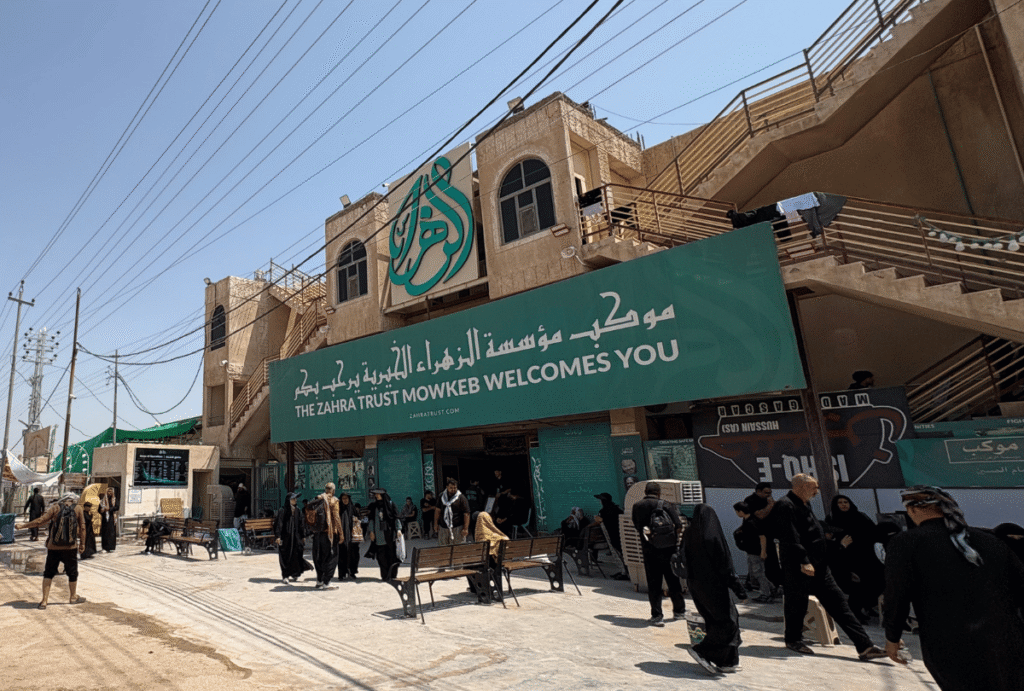
Every year during Arbaeen, millions of pilgrims travel towards Karbala to commemorate Imam Hussain (as) and reflect on the values represented by his sacrifice. Along this route exists a tradition that has become inseparable from the journey itself: the tradition of mowkebs.
Mowkebs, or mawakeb, are volunteer-led stations that provide support to pilgrims through food, water, accommodation, rest areas, medical assistance, and practical care. Yet their importance reaches far beyond these services.
They represent a culture built on devotion, remembrance, and generosity. Through mowkebs, communities transform belief into action and create an environment where hospitality becomes a form of worship.
For many people who experience Arbaeen, the presence of mowkebs leaves a lasting impression because they reveal how service can become a collective expression of faith.
The origin and meaning behind mowkebs
Today, mowkebs have become one of the defining features of Arbaeen.
Pilgrims walking towards Karbala encounter communities offering what they can, whether that means preparing meals, opening sleeping areas, distributing water, or helping those who need medical attention.
This culture of giving reflects principles found throughout the Quran. Allah (swt) says:
This verse captures something essential about mowkebs. Service is often offered quietly, continuously, and without expectation of recognition.
The spirit of generosity is reinforced again:
For those who contribute to mowkebs, giving becomes part of something greater than a single act.
How mowkebs became a defining part of Arbaeen
During periods of political restriction in Iraq, especially under Saddam Hussein, Arbaeen gatherings and the public establishment of mowkebs became prohibited.
Even during difficult times, communities continued to preserve remembrance in different ways.
After 2003, the tradition experienced a major revival.
What emerged was more than the return of a religious gathering. Mowkebs became part of one of the largest volunteer-supported movements in the world, with communities organizing independently to support millions of pilgrims.
Today, the route from Najaf to Karbala reflects a remarkable model of collective care.
The culture of service at the heart of mowkebs
The tradition of mowkebs is rooted in the idea that serving others can itself become an act of devotion.
Common services offered include:
Freshly prepared meals
Drinking water and refreshments
Accommodation and resting spaces
Medical and first aid support
Foot care and mobility assistance
Religious gatherings and recitation
These acts are often carried out by volunteers who dedicate time, effort, and resources purely for the benefit of pilgrims.
This understanding is reflected in the teachings of the Prophet (saww):
“No sooner does a Muslim serve a group of Muslims than Allah (swt) will give him servants equal in number (to the group) in Paradise.” (Al-Kafi, v.2, p.307, n.1)
Service within mowkeb culture is therefore not viewed as ordinary assistance, but as an opportunity for spiritual growth.
Imam Ali (as) is also reported to have said:
“The nourishment of the body is food whilst the nourishment of the soul is feeding others.”(Mishkat al-Anwar, n.325)
This understanding continues to shape how mowkebs operate today.
Following the example of the Ahlulbayt (as)
The values expressed through mowkebs reflect examples found throughout the lives of the Ahlulbayt (as).
Generosity, hospitality, and concern for others were not occasional acts but defining characteristics.
Imam Hussain (as) is remembered not only for sacrifice, but for dignity, compassion, and responsibility towards people.
This spirit continues to influence how communities approach Arbaeen.
Whether preparing meals before sunrise or helping exhausted pilgrims continue their journey, volunteers contribute because they see service as part of preserving these values.
Imam al-Sadiq (as) is reported to have said:
“A man who fulfils one need of his believing brother’s, Allah (swt) will fulfil one hundred thousand needs of his on the Day of Resurrection.” (Bihar al-Anwar, v.74, p.89, n.90)
This perspective helps explain why so many people return year after year to serve.
The Zahra Trust Mowkeb
While mowkebs remain most visible across Iraq, the values behind them continue to connect communities around the world.
At The Zahra Trust, participating in Arbaeen service has become one way we contribute to this tradition of care and devotion.
Through our mowkeb, we help provide:
Hot meals and clean drinking water
Rest and shaded recovery spaces
Medical and first aid assistance
Support for pilgrims from different backgrounds and languages
For us, this work is about more than practical support.
It is a way of honouring Imam Hussain (as) through service and extending the values of hospitality that continue to define Arbaeen.
Each year reminds us that the journey is sustained not only by those who walk, but also by those who stand ready to serve.
Why the tradition of mowkebs continue to matter today
Mowkebs remain a powerful reminder that remembrance can take many forms.
More than infrastructure, mowkebs represent a living tradition that continues to connect people across generations.
Their impact is measured not only by the services provided, but by the values they carry forward.
Serving the pilgrims of Hussain (as)
The tradition of mowkebs shows that Arbaeen is not only remembered through mourning. It is carried forward through service.
Every meal served, every space offered, and every act of support reflects a shared commitment to honouring Imam Hussain (as) through care for others.
Serve the path of Hussain (as).
Through supporting mowkebs and Arbaeen giving, we can continue helping pilgrims and sustaining the tradition of service that makes this journey possible.
Frequently asked questions
What is a mowkeb in the Arbaeen pilgrimage?
A mowkeb is a volunteer-run station that supports pilgrims by offering food, water, rest spaces, accommodation, and practical assistance throughout Arbaeen.
Who runs mowkebs?
Mowkebs are organized by volunteers, families, local groups, and charitable organisations committed to serving pilgrims.
Are mowkebs only found in Iraq?
Although most mowkebs operate in Iraq during Arbaeen, similar expressions of service and hospitality now appear internationally.
What services do mowkebs provide?
Services commonly include meals, water, accommodation, medical support, mobility assistance, and religious programs.
Why are mowkebs important?
Mowkebs reflect devotion to Imam Hussain (as) and embody values of service, remembrance, sacrifice, and hospitality.
Can international visitors access mowkeb services?
Yes. Mowkebs welcome pilgrims from many countries and backgrounds and aim to support all who take part in the journey.
More from Blog
The Future Starts with Education
Help vulnerable children access education, technology and skills for a brighter future. Support The Zahra Trust with a Back to School gift…
Rebuilding Futures Through Education: Restoring Hope, Dignity and Opportunity
When communities experience crisis, the effects can continue long after the immediate hardship has passed. Conflict, poverty, and displacement can interrupt a…
From Backpack to Graduation: The Ripple Effect of Education
Learn how an education donation can help remove barriers to learning and support a child's journey from school towards adulthood. Donate today…