
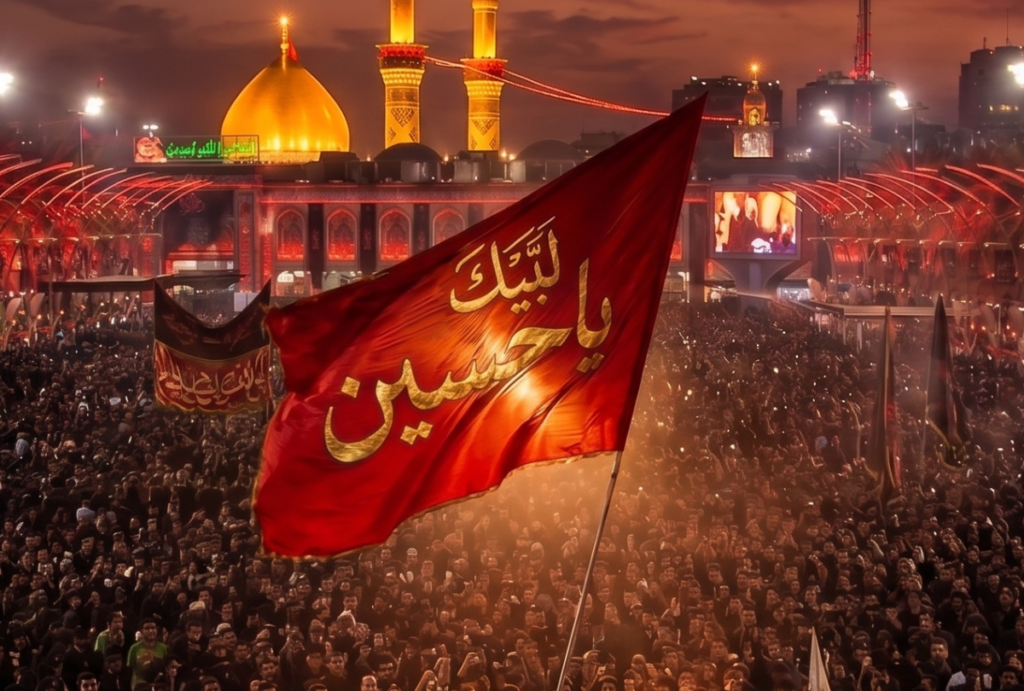
To understand what “Labbayk Ya Hussain” means today, we must go beyond translation and look at its lived meaning. These words are not only recited during Muharram. They are spoken as a response, a declaration of readiness, and a reflection of loyalty to Imam Hussain (as).
“Labbayk Ya Hussain” means “Here I am for Hussain.” It is an answer to a call that continues to echo through time, reminding believers that the message of Karbala is not limited to history. It remains a moral guide for how to respond to injustice and human suffering in the present day.
The core meaning of Labbayk Ya Hussain
The word labbayk means “here I am” or “at your service.” It expresses immediate response, loyalty, and willingness to act.
When connected to Imam Hussain (as), it becomes a declaration of allegiance to his mission of truth, justice, and resistance to oppression.
This phrase is not about invoking Hussain (as) independently. Rather, it is about affirming commitment to his path, which represents a life of integrity and sacrifice for higher principles.
A Quranic foundation: Standing with justice
The message of Karbala strongly aligns with the Quranic principle of standing for justice and promoting good.
Allah (swt) says:
This verse establishes a clear responsibility for believers to actively promote goodness and resist wrongdoing. It is not a passive instruction but a call to engagement and moral courage.
When viewed in this light, the message of Imam Hussain (as) reflects this Qur’anic command in action. His stand in Karbala represents the highest expression of commanding right and standing against injustice, even in the face of overwhelming difficulty.
Loyalty through the example of the martyrs of Karbala
Imam Hussain (as) continues to resonate not simply because of what happened in Karbala, but because of what his choices represented. His refusal to compromise principles for comfort or authority has made his example enduring across generations.
The teachings associated with the Ahlulbayt (as) consistently connect faith with responsibility toward others. Justice is not treated as an abstract ideal but as something expressed through conduct, compassion, and accountability.
Through this lens, remembering Karbala becomes more than preserving history. It becomes an invitation to ask what loyalty looks like in everyday life and how values are carried forward through service, integrity, and concern for others.
The emotional depth of remembering Hussain (as)
The Prophet (saww) is reported to have said:
Mustadrak al Wasail v.10, p.318
This narration reflects the enduring emotional connection believers carry toward Imam Hussain (as). His memory does not fade into history. It continues to live in hearts across generations.
But this emotional depth is not meant to remain only as feeling. It becomes a motivation that pushes believers toward action rooted in his values.
What “Labbayk Ya Hussain” means in today’s world
It can be understood as:
- Standing for justice when injustice is visible
- Offering support to those in hardship
- Keeping Karbala’s values alive through service
- Transforming remembrance into meaningful action
In this way, the phrase becomes a guide for ethical living rather than only a devotional expression.
Turning remembrance into responsibility
To answer the question, “What does ‘Labbayk Ya Hussain’ mean today?” is to recognise that it is not only a phrase of mourning. It is a call to action.
Imam Hussain (as) stood for truth, justice, and dignity in the face of oppression. His message challenges believers today to carry those same values into the world around them.
This is why remembrance cannot remain only emotional. It must become practical, lived, and visible through service to others.
FAQs
What does “Labbayk Ya Hussain” mean in simple terms?
It means “Here I am for Hussain” and expresses readiness to follow his values of truth, justice, and sacrifice.
Is “Labbayk Ya Hussain” only a mourning slogan?
No. It is also a declaration of action, encouraging believers to live by Imam Hussain’s (as) principles.
How is “Labbayk Ya Hussain” connected to Karbala?
It reflects loyalty to Imam Hussain (as) and his stand against injustice during the tragedy of Karbala.
Can saying “Labbayk Ya Hussain” include charity?
Yes. Many believers express it through acts of charity such as volunteering and donating.
What does Islam say about standing up for justice?
The Quran encourages believers to promote good and prevent wrongdoing, as stated in verse 104 of Surah Aal-Imran.
Why do believers feel emotional when remembering Imam Hussain (as)?
For many believers, remembering Imam Hussain (as) is not only about reflecting on a historical event. Karbala represents sacrifice, faith, moral courage, and standing for truth in the face of injustice.
More from Blog
Rebuilding Futures Through Education: Restoring Hope, Dignity and Opportunity
When communities experience crisis, the effects can continue long after the immediate hardship has passed. Conflict, poverty, and displacement can interrupt a…
From Backpack to Graduation: The Ripple Effect of Education
Learn how an education donation can help remove barriers to learning and support a child's journey from school towards adulthood. Donate today…

What’s Inside a Sponsored Classroom?
When we picture a classroom, we often think of desks, books, and a teacher leading a lesson. For a child living through…